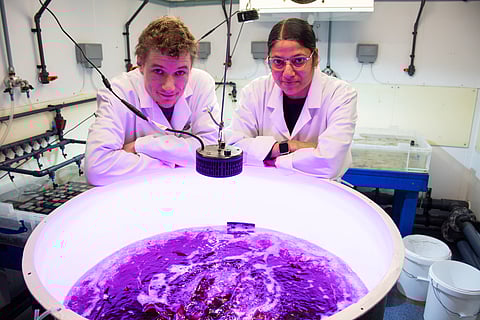


Dr Frederik De Boever and Dr Puja Kumar with tank-grown Palmaria palmata at SAMS lab facilities in Oban.
Photo: Scottish Association for Marine Science (SAMS)

A team of marine scientists in Oban, Scotland, say they have significantly reduced losses in the early life stage of dulse, a high-value red seaweed. By refining how the seaweed is grown in tanks, the researchers have addressed one of the main barriers to expanding commercial production.
The work, carried out at the Scottish Association for Marine Science, focuses on Palmaria palmata, a species of red seaweed that grows naturally along the Atlantic coast and is sold as a food product, as well as used in feed, cosmetics, dyes and pharmaceuticals. According to the researchers, it can fetch prices far higher per tonne than kelp.
However, cultivation has thus far proved difficult, with limited natural stocks and seaweed farmers reporting mortality rates of 60–70% at the spore stage in hatcheries, often linked to disease. The plant’s reproductive cycle adds further complications, as male and female plants mature at different times and the reproductive window is short.
The Oban team focused on this early phase: by adjusting the microbial balance in the tanks, including introducing natural grazers and using probiotic methods to limit disease, they say they have managed to reduce mortality in spores to around 10%.
“The growth is phenomenal,” said Dr Frederik De Boever, a microbiologist involved in the research. “We’re growing the seaweed from the spore stage to germlings, which increases resilience, compared with vegetatively cut thalli from established adult seaweeds."
“The spore to germling mortality rate is usually high but in the lab we have more control over that crucial life stage,” he explained.
The researchers report that biomass in their aquarium system has been doubling each week under trial conditions. They say the combination of improved hatchery management and land-based tanks allows greater environmental control than with open-sea farming. According to the team, the resulting biomass shows low iodine and metal accumulation, and the system allows year-round production.
The project forms part of the "FABRICS" project, led at SAMS by Dr Puja Kumari. She said that, while large brown kelps dominate much of the discussion around seaweed farming in Europe, red seaweeds account for about half the global value of seaweed production.
“When discussing seaweed cultivation, a lot of focus is often on large kelps that generate lots of biomass, but more research effort is required to help expand and diversify the cultivation of red seaweeds in the region,” she said.
“Red seaweed cultivation is important for the seaweed aquaculture industry because it contributes to half the net worth of world seaweed production. There is therefore an urgent need to diversify seaweed cultivation practices to include important UK and European red seaweeds to help address the uncertainty in the red seaweed global market supply, as well as address sustainability and net zero targets,” Kumari added.
Global supply of red seaweed is largely concentrated in a small number of Asian species, some of which are facing pressure from climate change and disease outbreaks. The researchers suggest that developing reliable methods for European species such as Palmaria palmata could help reduce dependence on imports and support domestic supply chains.
FABRICS is funded by UKRI-BBSRC and involves commercial partners including W. L. Gore & Associates and SeaDyes, a start-up based at the James Hutton Institute. Jessica Giannotti, founder and chief executive of SeaDyes, said the company is seeking to secure a scalable supply of red seaweed biomass for its dye technologies.
“Through our involvement in the FABRICS project, SeaDyes is working to establish a scalable and resilient supply of red seaweed biomass to underpin our sustainable dye technologies,” she said.
“By addressing critical bottlenecks and supporting the expansion of red seaweed cultivation in Scotland, FABRICS strengthens domestic supply chains, reduces risk, and helps complete the seaweed-based value chain for downstream innovators," Giannotti added. “As a future off-taker of large quantities of biomass, our role in the project is to validate land-based cultivated biomass for biotechnology applications, ensuring it meets the quality, performance and scalability requirements of our bio-based dye platform.”
