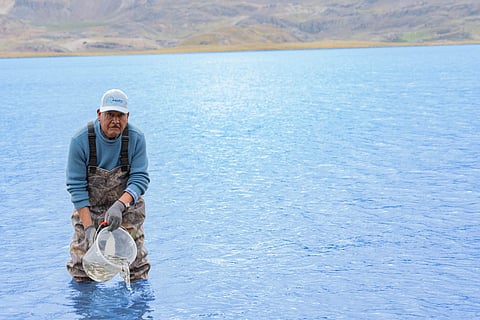


Release of rainbow trout fingerlings into Lake Orccococha in Castrovirreyna, Huancavelica Department, Peru.
Photo: Gobierno Regional de Huancavelica.

After more than 25 years of pollution caused by mining activities, the main event of the 'Orccococha Lake Recovery Plan'—the tourism and aquaculture initiative 'Orccococha Renace' (Orccococha Reborn)—took place last weekend, marking a milestone in the recovery and restoration of this important high-Andean ecosystem in southern Peru, as well as in the productive development of the area.
A central part of the event involved the release of 90,000 rainbow trout fingerlings, as well as the installation of a floating cage system, which, as noted by Peru's Ministry of Production (Produce), is a key piece of infrastructure for strengthening local aquaculture.
Economic activity on the lake will be driven not only by fish farming but also by tourism-related activities such as boat rides, guided lake tours, and culinary experiences featuring trout, establishing Orccococha as a new destination for experiential tourism and sustainable aquaculture.
"These actions help establish aquaculture as a viable and strategic alternative for creating jobs, improving family incomes, and responsibly utilizing the region's water resources through technical management and controlled farming practices," Produce stated in a release.
The Peruvian Ministry of Production added that this also promotes the expansion of aquaculture, creating new opportunities for the sustainable development of the area.
Located more than 4,600 meters above sea level, Lake Orccococha covers an area of more than 1,600 hectares and holds approximately 290 million cubic meters of water, making it a strategic site for aquaculture, tourism, and environmental development in Huancavelica.
The restoration of this lake joins that of others, such as Pultoc and Choclococha, helping to consolidate the 'Espejos del Agua' (Water Mirrors) tourist route, which opens up new opportunities for economic development, food security, and, as mentioned, the revival of productive activity in the region.
The leaders gathered at the event—held in conjunction with the release of rainbow trout fingerlings into Lake Orccococha in Castrovirreyna, in the department of Huancavelica—emphasized that the lake's recovery has been made possible thanks to the political will and sustained technical efforts of all parties currently involved.
In addition to representatives from the Regional Government of Huancavelica and the communities of Santa Inés, Santa Ana, and Caudalosa, the event also included representatives from the Ministry of the Environment, the National Agricultural Health Service (SENASA), the Peruvian Institute of the Sea (Imarpe), the Technological Institute of Production (ITP), as well as private institutions, nongovernmental organizations, and the mining company Reliquias, strategic partners in this process.
All of them have contributed to this initiative, whose main objective, as mentioned above, is to revitalize the local economy through the sustained growth of aquaculture, thereby promoting the expansion of production capacity.
Produce noted that the project is based on prior technical studies conducted by the ITP, which confirmed that Lake Orccococha offers favorable conditions for trout farming, thereby ensuring the efficient and sustainable management of the resource.
Likewise, during the event, ITP also expressed its gratitude for the agreement with the Regional Government of Huancavelica to open the Aquaculture and Fisheries Technical Unit at the Lircay Fisheries Station, which will provide technological support and assistance to aquaculture producers, promoting the use of innovation to improve the sector's competitiveness.
For his part, the representative from Imarpe noted that, under the agreement signed with the Regional Government, water studies are currently being conducted, and the region will receive fish eggs, feed, and specialized technical assistance to boost trout production.
Finally, the Governor of Huancavelica reaffirmed his commitment to continuing to promote environmental recovery, productive development, and sustainable tourism, highlighting the coordinated efforts with institutions, the private sector, academia, and civil society. He also announced that access roads will continue to be improved to facilitate the transport of aquaculture products and boost tourism in the area.
