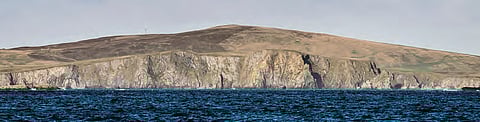


The salmon farm will be located at Billy Baa.
Photo: Scottish Sea Farms.

In its latest newsletter for 2025, Scottish Sea Farms announced what it, in its words, "marks an exciting new chapter for Scottish Sea Farms' operations in Shetland." With the stocking of Scotland's largest farm to date at Billy Baa and plans underway for new developments to improve fish health, the company is ushering in what it has defined as a "new era of farming" in the area.
Scheduled to become operational in May 2026, the farm—which has a biomass consent of 4,091 tons and will create eight full-time jobs—is in line with the company's strategy of having larger farms in better locations, with deeper waters and faster currents.
The new site will have nine 160-meter cages—the first of this size in the Shetland Islands—and one 120-meter cage. In addition, the company noted that the average depth at Billy Baa is 45 meters, making it one of the deepest farms in the area.
"With the depths at Billy Baa and the new 160m pens, our fish will have more room than ever to grow," Richard Darbyshire, Regional Manager of Scottish Sea Farms for Shetland, explained to The Source, the company's newsletter. "These larger pens in larger grids improve the water flow through the farm and lead to better performance and survival," he added.
Jointly owned by Norwegian salmon producers SalMar and Lerøy Seafood, Scottish Sea Farms pointed out that, nevertheless, most of the expenditure on the new farm, which has involved an investment of GBP 7.5 million, has gone to Scottish suppliers.
Among these, the company highlighted, for example, that the workboat, valued at GBP 1.8 million, is being built by MacDuff Ship Design, and the cages and moorings are being supplied by Gael Force Marine, based in Inverness.
The pen systems chosen are the SeaQurePen 500 model. Designed to withstand the demanding environment of Shetland, Scottish Sea Farms said they will provide a much-improved working platform for the farm staff. A tried and tested double net system has also been installed, with a 75mm mesh outer net and an 18mm mesh inner net, as well as a new 'glider' system for the nets to ensure correct tension throughout.
For its part, ScaleAQ in Scotland supplied the cameras and the 500-ton steel feed barge, which, in addition to being the company's largest barge to date, is also equipped with its most advanced hybrid system.
"We are installing a Fjord Marine Hybrid system from Fjord Maritime, to power the feed barge," said Richard Darbyshire. "We trialled the technology on one of our existing farms and made fuel and maintenance savings worth GBP 250,000, so have decided to increase the size to give even greater savings and reliability."
"We will also be using the latest ultrahigh-definition feed cameras, along with a new motorised feed spreader that will reduce power consumption and increase feed spread and availability," the Regional Manager of Scottish Sea Farms for Shetland continued.
"The sector is constantly evolving, and our aim is to reduce the carbon footprint of the salmon we produce even further," he added.
In its article in The Source, Scottish Sea Farms highlighted that combining scale and sustainability also provides producers with the most reliable systems for safeguarding fish health and welfare. The company said that the new operation at Billy Baa exemplifies its mission to farm sustainably, incorporating innovations to improve fish health and minimize environmental impact.
"There will always be environmental challenges so we are continually looking to new technologies to enhance fish health and survival," stated Robbie Coutts, Scottish Sea Farms' Area Manager at West Shetland.
"We have just had the warmest ever seawater temperatures on our Shetland farms, with several weeks in the height of summer 1.5°C warmer than the seasonal norm. This helps with fish growth, but leads to issues with water quality, oxygen levels and the speed of AGD progression," he explained.
Scottish Sea Farms' Area Manager at West Shetland also said that the company has a sophisticated water quality analysis laboratory in Lerwick and has implemented a daily water quality monitoring protocol at each Shetland site, with a traffic light system to alert farms when high levels of plankton and micro jellyfish are detected.
Robbie Coutts also explained that improved aeration technologies allow them to bring colder, deeper water to the surface during these events, with greater oxygen availability and fewer potentially harmful algae and jellyfish.
"We have also invested in increased wellboat capacity to perform freshwater reverse osmosis treatments for AGD and sea lice, with 2500m3 and 2200m3 vessels that operate in Shetland. And in the past 12 months, we have added FLS delousing capability to these wellboats," he added.
However, the launch of Scotland's largest farm to date is not Scottish Sea Farms' only goal for 2026. The company also announced that it intends to increase the smolt transfer size from the current 130 g to shorten the production cycle in sea cages and reduce the number of times the fish are handled.
As Rory Conn, the company's Head of Freshwater explained last October—when Scottish Sea Farms announced that it had upgraded its freshwater hatchery in Knock, on the Isle of Mull, to increase its flexibility—in recent years, the company has joined the post-smolt trend, more than doubling the average size of smolt.
Moreover, Scottish Sea Farms noted that in its pipeline for 2026 and beyond is moving further offshore to locations that are even deeper and have improved tidal flow.
"We have identified some potential sites that show promise, including Fish Holm in the Setterness area, an existing farm which we are looking to expand," said Richard Darbyshire.
"The hydrodynamics are extremely favourable and are very similar to the strongly flushed farms in Orkney that have produced solid farming results," the Regional Manager of Scottish Sea Farms for Shetland added.
