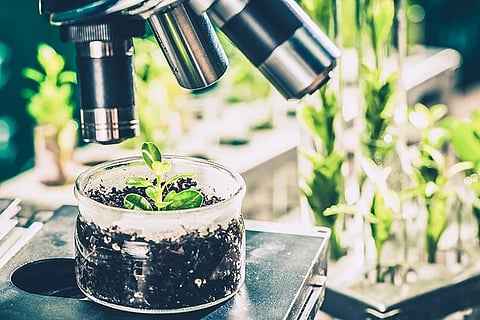


Skretting's parent company, Nutreco, has a division specializing in plant research and the development of unique novel ingredients.
Photo: Skretting Norway.

Launched last October, Skretting's new plant-based functional fish feed has now arrived in Norway. Under the brand name Necto, the company is introducing phytocomplexes to Norwegian salmon for the first time, an innovation that harnesses the natural complexity of plants to provide a holistic nutritional solution that supports fish health and resilience.
"It represents a new way of working with fish health through nutrition. The industry needs more tools to strengthen fish resilience in the face of an increasingly complex range of challenges," said Margunn Sandstad, Fish Health Manager at Skretting Norway, commenting on the new product.
This launch marks the beginning of a broader innovation strategy, which will involve developing new phytocomplexes for the aquaculture industry. Researchers believe that in an industry facing increasing biological challenges, this technology could open new avenues to improve fish resilience and welfare.
As Skretting explained in the release announcing Necto's launch in Norway, phytocomplexes consist of combinations of bioactive compounds derived from plants, making use of the interaction between multiple components rather than isolating individual substances.
"Plants represent a vast and partly untapped potential. When nature's own compounds work together, we achieve a stronger effect than they do individually. The challenge has been understanding how these components can be used in a precise and consistent way. Now this work is beginning to materialize into solutions for the aquaculture industry," explained Linda Jensen, Researcher and Health Team Leader at Skretting Aquaculture Innovation.
Skretting's parent company, Nutreco, has a phytotechnology program that harnesses the power of the plant kingdom for application in aquatic species and livestock. The phytocomplexes now in use were created specifically for use in aquaculture in collaboration with Nutreco Exploration, the division specializing in plant research and the development of novel and unique ingredients.
The ultimate goal is to simultaneously influence several biological processes in the fish and thus support its physiology more holistically, so that it develops better conditions to withstand stress, handling and the pressure of diseases, thereby promoting greater welfare and, consequently, more stable production.
In the specific case of the Norwegian market, Skretting is introducing this innovation with a special focus on helping salmon cope with chronic inflammation, which has become an increasing problem in Norwegian aquaculture in recent years. Over time, this condition can affect the fish's resilience, their ability to manage stress, and their overall well-being, weakening the salmon and increasing mortality.
In the search for ways to support fish under demanding production conditions, the aquafeed company sees phytocomplexes as a new opportunity. Controlled trials have shown promising results, including a reduction in the expression of genes associated with inflammation and a decrease in mortality. Now, the goal is to gain practical experience using phytocomplexes under commercial conditions.
"For fish farmers, this is relevant because better control of chronic inflammation can contribute to more robust fish, improved fish welfare, and support production. This is the practical value we want to continue testing and documenting," Sandstad stated.
At the same time, the Fish Health Manager at Skretting Norway emphasized that nutrition is only one of several factors involved in strengthening fish health. "The health challenges in aquaculture are complex. Functional health feeds are not a standalone solution, but part of a broader approach in which different measures must work together," she stated.
