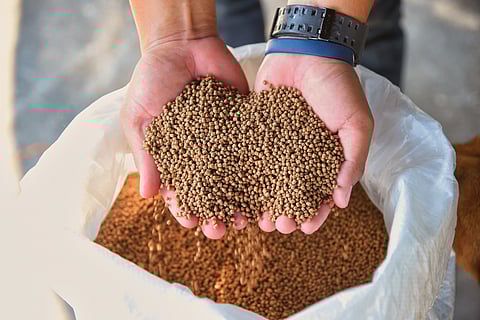


Aquaculture feed.
Photo: Adobe Stock

The International Platform of Insects for Food and Feed (IPIFF) has called on the European Union to introduce mandatory inclusion rates for insect ingredients in aquafeed, arguing that binding targets are needed to move the sector from limited uptake to wider commercial use.
In a position paper submitted to the European Commission’s consultation on its future Vision 2040 for fisheries and aquaculture, IPIFF proposes progressive targets of 3% in 2027, 5% in 2028, 7% in 2029 and 15% by 2030, alongside a longer-term goal of 50% by 2050.
The organisation argues that mandatory inclusion rates would create demand, improve market certainty for producers and help reduce the sector’s exposure to volatile raw material prices.
IPIFF also links the case for insect meal to the EU’s broader feed protein deficit. According to the paper, the bloc relies on imports for around 70% of its animal feed protein, including soy and fishmeal, leaving the bloc vulnerable to supply shocks, geopolitical instability and climate-related disruption. Insect meal, produced within Europe in controlled environments, is a more secure and circular alternative, the organisation maintains.
The paper also stresses the potential benefits for aquaculture in the EU, arguing that feed remains one of the sector’s biggest cost and sustainability challenges.
"Over a decade of peer-reviewed science and commercial application has validated insect meal not just as a novel ingredient, but as a high-performing, functional, and environmentally beneficial component of a sustainable aquafeed strategy," the IPIFF argues, citing evidence that insect ingredients can be used without harming growth performance, while also offering potential benefits linked to gut health, immune response and antioxidant activity.
At the same time, the group contends that wider use is still being held back by economics and regulation rather than technical feasibility, with insect meal remaining more expensive than competing ingredients such as soy protein concentrate, while the current regulatory framework does too little to reward sustainability. "The primary barriers are no longer technical, but systemic," the organisation argues.
Alongside its proposal for mandatory targets, IPIFF is also calling for wider reforms, including stronger sustainability and traceability requirements for imported feed ingredients, expanded rules on permitted substrates for insect production, and better access to EU funding for industrial scale-up - including granting the insect industry access to funding under the Common Fisheries Policy and European Maritime, Fisheries and Aquaculture Fund (EMFAF).
"The EU stands at a critical crossroads: it can continue with a vulnerable and environmentally costly status quo, or it can act decisively to unlock the potential of a circular, resilient, and innovative European industry. The scientific foundation is solid; the industry is ready," IPIFF states.
"The path forward is clear: by adopting the targeted policy measures outlined above—particularly mandatory inclusion rates—the EU can turn proven potential into market reality, fulfilling the objectives of a sustainable and competitive aquaculture sector," it concludes.
The full IPIFF position paper can be accessed via the EU Commission feedback portal.
