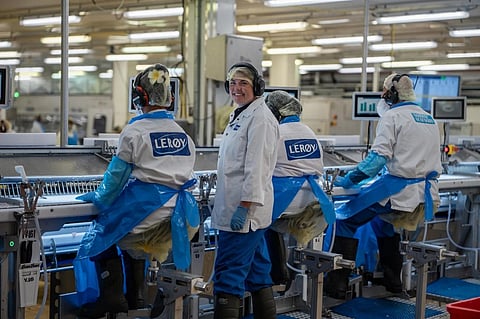


The Lerøy Seafood Group processing plant in Melbu, Vesterålen, Norway, one of the company's historic facilities.
Photo: Lerøy Seafood Group.

After profits tumbled 96% year-on-year in Q3—only offset by record processing results—the solid operations and good biological performance recorded in Q4, along with, once again, the extraordinary performance of the Value-Added Processing, Sales and Distribution (VAP S&D) segment, which closed 2025 as its best year ever, marked Lerøy Seafood Group's recovery in the last quarter of last year.
Driven by higher prices in the Wild Catch segment and increased activity in VAPS&D, although partially offset by lower harvest volumes in Farming, in Q4 2025, the Group's revenue increased by 4% year-on-year, reaching NOK 8.83 billion. Operational EBIT amounted to NOK 758 million, slightly down (-5%) from NOK 799 million in Q4 2024.
"The result reflects good underlying operations across the Group, with solid contributions from Farming and a very strong quarter in the Value-Added Processing, Sales and Distribution (VAP S&D) segment. Although the year has been characterised by low salmon prices, the fourth quarter demonstrates the effect of a robust and fully integrated value chain," the CEO of Lerøy Seafood Group, Henning Beltestad, said, commenting on the results.
For the year as a whole, supported by higher farming volumes and the solid activity in value-added processing sales and distribution, despite lower salmon and trout prices that marked 2025, revenues grew by 10% to reach NOK 34.36 billion.
Regarding the Farming segment, Lerøy Seafood Group said that operational EBIT amounted to NOK 564 million in the fourth quarter of 2025, 5% lower than in the corresponding period last year. For the full year, operational EBIT was NOK 1.30 billion, which represented a 42% decrease compared to NOK 2.25 billion in 2024.
"Prices for salmon and trout improved significantly towards the end of the quarter, while biological performance was somewhat better than expected. Costs declined quarter-on-quarter, and we enter 2026 with a good biological situation," Beltestad explained.
The VAP S&D segment, meanwhile, recorded operational EBIT of NOK 317 million in Q4, representing a 15% year-on-year increase. Full-year 2025 operational EBIT reached NOK 1.29 billion, which, according to the company statement, means that its ambitious target of NOK 1.25 billion set in 2022 has been achieved.
"We have built profitability over time through increased volumes, improved capacity utilisation and targeted improvement initiatives. This represents an important milestone for Lerøy, and 2025 is clearly the best year in the history of this segment," said the Group CEO.
Finally, the Wild Catch segment delivered an operational EBIT of NOK -29 million in the fourth quarter, compared with NOK 6 million in the same quarter last year, which represented a 616% year-on-year drop in the quarter.
"Lower catch volumes as a result of reduced quotas, combined with high raw material prices, impacted margins in the land-based industry," Lerøy noted in its statement. However, for the full year, with a result of NOK 270 million, operational EBIT increased by 108% compared to 2024.
In addition, Lerøy Seafood reported that the profit contribution from associated companies and joint ventures was NOK -68 million before fair value adjustment related to biological assets in Q4 2025, compared to NOK 15 million in Q4 2024, which is equivalent to -543%.
The Group said the decrease is attributable to challenging biological development for Norskott Havbruk, owner of the Scottish salmon farming company Scottish Sea Farms Ltd., which Lerøy co-owns with fellow Norwegian producer SalMar. For the full year, income from associated companies was NOK -70 million, a 40% increase compared to NOK -117 million last year.
Based on these results, Lerøy Seafood Group expects a lower cost per kilo produced in the farmed segment by 2026 compared to 2025.
The company maintains its projected harvest volume in Norway unchanged at 195,000 GWT, and expects the total volume, including Lerøy's stake in Scottish Sea Farms, to reach 216,500 GWT in 2026.
"Continued good biological development results in high harvest volumes and also affects salmon prices at the beginning of 2026. This leads to lower earnings in the short term, but the good biological situation is positive over the longer term," said Henning Beltestad.
"Over time, Lerøy has developed a strong and future-oriented value chain, and we look forward to presenting our strategy and long-term targets at the Capital Markets Days on 2-3 March 2026," Lerøy Seafood Group CEO concluded, emphasizing his previous statement that Q4 2025 results have demonstrated the effect of a robust and fully integrated value chain.
