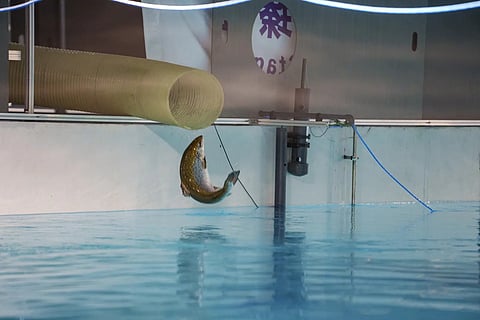


Image of fish transfer to the first RAS grow-out unit in the Phase 2 facility in October 2025. During Q1 2026, NOAP completed the transfer of fish into all units.
Photo: Nordic Aqua Partners.

Nordic Aqua Partners (NOAP) today released its operational update for the first quarter of 2026. The results demonstrate that its bet last year on a strategy focused on larger fish —which led it to lower its total harvest guidance for 2025— is now paying off.
Thus, in the statement to the stock exchange issued today, China's first commercial-scale RAS Atlantic salmon farm said that during Q1 2026, it increased harvest volumes, and achieved both higher average weights and a higher superior rate.
Specifically, NOAP's commercial harvest amounted to 771 tons of head-on gutted (HOG), reaching an average harvest weight of 4.4 kg HOG, equivalent to 5.4 kg live weight (LW), with a superior quality rate of 95%.
In addition, the company reported that the overall biological performance at its farm on Gaotang Island, Ningbo, in China, remains solid, with good fish health, no maturation, and high survival rates.
During the quarter, production increased to 2,161 tons, bringing the total biomass to 4,991 tons, and is now close to full operating capacity for Phases 1 and 2 combined.
In this Q1 2026 operational update, Nordic Aqua also said that Phase 2 is nearing completion, as it has now successfully transferred fish into all grow-out RAS units—the first of these transfers was completed on October 10, 2025.
According to NOAP's release, the first harvest from Phase 2 fish is expected to be in September 2026. The land-based salmon farming company operating in China will thus take another step in its current business plan, which contemplates an annual production of 20,000 tonnes (HOG).
Presenting its Q4 2025 results report, Nordic Aqua Partners claimed that the good biological performance and excellent fish health and welfare at its Ningbo farm at the end of the year, as well as the execution of strategic agreements that strengthened its financial platform, provided a "clear path" to this target.
Specifically, the company highlighted then that these strategic agreements materially strengthen the company's capital structure, liquidity and long-term growth platform in China, enhancing execution visibility towards the targeted 20,000 tons annual capacity.
