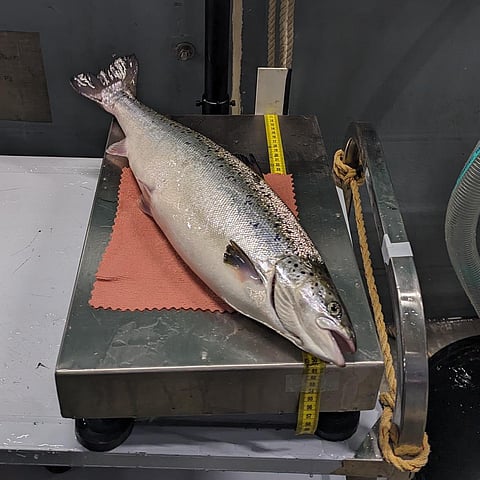


A 2.2 kg salmon at Proximar Seafood's facility in Oyama, Japan, in April 2024. The average harvest weight in Q2 2026 stood at 2.56 kg HOG.
Photo: Proximar Seafood.

A month ago, Proximar Seafood announced it had reduced its full-year harvest guidance after lower-than-planned fish weights and weaker market conditions affected its revenue in the first quarter of 2026. Now, by presenting its Q2 2026 production update, the Norwegian land-based salmon producer operating in Japan has confirmed that the targeted harvest of smaller fish began in June.
As expected, this adjustment affected the average harvest weight in the second quarter, which stood at 2.56 kg HOG (Head-On-Gutted). Despite this, Proximar stated that harvest sizes continue to show an upward trend, increasing from approximately 2.25 kg HOG in the previous quarter, "demonstrating continued positive size distribution developments," it said.
As the company explained, this targeted harvest of smaller fish aims to free up tank capacity and prioritize increasing the average harvest size to above 3 kg, a size that marks the achievement of better prices.
With that average weight of 2.56 kg, the average net selling price in Q2 2026 was approximately NOK 64 per kg. Although this was an improvement over the NOK 54 per kg of the previous quarter, Proximar noted that the price continued to be affected by a weaker spot market and limited contract sales volume of fish over 3 kg.
For those fish weighing more than 3 kg HOG, the average price obtained was approximately NOK 75 per kg, thus maintaining the same price obtained in Q1 2026. "Despite the weaker spot market, sales prices with our loyal customers remained stable, highlighting the value of contracted customers," the company stated in its note to the stock market.
In total, during this second quarter, Proximar Seafood harvested 726 tons HOG, which represented an increase of 4.16% compared to the 697 tons HOG of the first quarter of this year, bringing the company's total harvest since it began harvesting in September 2024 to around 2,800 tons of HOG.
Regarding biological indicators, Japan's first large-scale salmon farm said they remained strong, with 99.3% of fish being of superior grade during the quarter and a survival rate of 98.9% in the grow-out phase.
Nevertheless, Proximar also reported that during the quarter, feeding was temporarily impacted by elevated turbidity, a problem that had already affected the salmon farmer in Q4 2024, when it experienced two biofilter incidents, but which it declared solved without mortality by the end of that same quarter.
According to the release, the current problem was "likely caused by operational parameters, with the root cause still being identified." However, the land-based salmon producer added that, since then, turbidity levels have improved and no longer limit feeding, while the fish's appetite continues to improve.
Thus, as of June 30, 2026, standing biomass totalled 1,730 tons, compared to 1,880 tons as of March 31, 2026. Including the harvested biomass of 875 tons live weight (LW), the gross biomass growth for the quarter was 726 tons. Currently, the company has approximately 2.1 million healthy salmon in production.
Proximar Seafood, which secured a bank waiver at the end of April linked to lower sales volumes in the first quarter, concluded its Q2 2026 production update by stating that it expects market conditions to improve during the third quarter, supported by increased contract sales.
