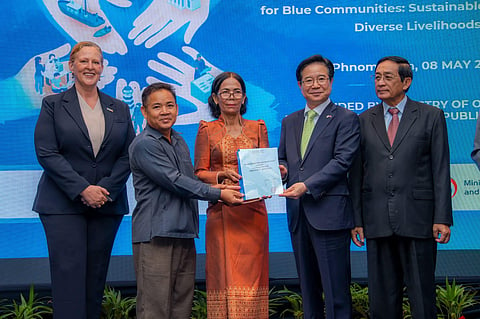


This three-year project is supported financially by the Republic of Korea.
FAO

The Food and Agriculture Organization of the United Nations (FAO) has concluded the Smart Fisheries Co-Management (SFC) Project in Cambodia, implemented by the Fisheries Administration (FiA) of the Ministry of Agriculture, Forestry and Fisheries (MAFF).
This three-year project, supported financially by the Republic of Korea, has helped strengthen fisheries co-management by prioritizing local communities and creating new livelihood opportunities.
"Our collaboration, including study visits to Korea, has strengthened the ties between our two nations. The project's achievements reflect the strong cooperation between MAFF, FAO, local communities, and development partners under the leadership of the Royal Government of Cambodia," said H.E. Chang Yong Kim, Ambassador of the Republic of Korea to Cambodia.
Among its key activities were the participation of more than 900 people in consultations, training sessions, and study visits. From pond-based aquaculture in Stung Treng to ecotourism initiatives in Kratie, these efforts have enabled local families to boost their incomes while preserving their natural environment.
The project also enabled the updating and approval of Community Fisheries Area Management Plans, the re-election of committees, and the strengthening of monitoring and enforcement measures.
Finally, the project supported investments in 15 household fishponds, the provision of key equipment, and the development of ecotourism infrastructure such as boats, homestays, and community centers.
"The achievements of this project are a clear example of Cambodia's progress in strengthening community fisheries. We are building a system that supports our people, protects our resources, and secures the future of our fisheries sector," stated H.E. Has Saret, Secretary of State at the Ministry of Agriculture, Forestry and Fisheries, during the closing ceremony.
From now on, integrated programmes will be implemented to restore ecosystems, improve water and habitat management, and increase fisheries productivity in the Mekong River and Tonlé Sap systems, to strengthen the livelihood resilience of communities that depend on fisheries.
