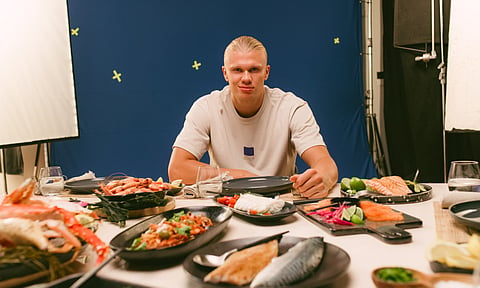

Erling Braut Haaland encourages the consumption of Norwegian seafood with messages such as "Eat your best. Be your best."
Photo: Norwegian Seafood Council.

Early Monday morning, June 22, in the midst of the World Cup, Erling Braut Haaland and Norwegian seafood took over one of the world's most iconic advertising spaces. For 24 hours, a video featuring the Norwegian national team striker played on the main screen at One Times Square, in the heart of New York City, encouraging the U.S. to choose Norwegian salmon.
The Times Square display is part of a larger campaign in the U.S. promoted by the Norwegian Seafood Council (NSC), which began on June 1 and will run throughout the World Cup. Visible across much of the East Coast, including Boston and New York, it is specifically targeted at US consumers interested in health, nutrition, and lifestyle.
To achieve this, the campaign, which combines digital outdoor advertising with television and social media, takes advantage of the enthusiasm generated by the World Cup with messages such as "Eat your best. Be your best."
"We know that Americans are attracted to winners and strong personalities. Haaland gives us a powerful platform to connect seafood with performance, energy, and good choices," explained Karine Rød Haraldsson, the NSC's envoy to the United States.
"This is a unique opportunity to put Norwegian seafood on the map, with one of the world's most recognizable sports stars as our ambassador," she added.
As NSC noted, this campaign running along the U.S. East Coast during the World Cup builds on the partnership agreement signed in 2024 between the Norwegian Seafood Council, the Norwegian Football Federation, and Erling Braut Haaland—his debut market was South Korea in September of that year—, which was extended in March of this year.
In the specific case of the United States, even before the World Cup, according to studies conducted in 2025, the level of awareness of Norway's national football team star on the northeast coast of the country reached 54%.
The fact that this now coincides with the World Cup and Haaland's presence in the tournament—where, at the time of writing, he has already scored four goals, leading Norway to qualify for the next stage of the 2026 World Cup, after 28 years without participating in one—is yet another point in favor of his selection as ambassador for Norwegian seafood.
The marketing organization, which works together with the Norwegian seafood industry to increase the value of its products in established and new markets worldwide, reported that preliminary measurements have shown that the campaigns with Haaland are achieving very positive results.
"We are seeing higher levels of attention than with other campaigns, a stronger association with the 'Seafood from Norway' brand, and—most importantly—increased purchase intent for Norwegian seafood," Haraldsson said.
Karine Rød Haraldsson, the Norwegian Seafood Council's envoy in the U.S., with Seafood from Norway advertisements featuring Haaland in Times Square, New York.
Photo: Norwegian Seafood Council.
The campaign led by Erling Braut Haaland is therefore achieving what the NSC has set as its "clear objective": to encourage more people in the U.S. to choose seafood, and preferably Norwegian salmon.
The Norwegian Seafood Council noted that currently only about 6% of animal protein consumed in the United States comes from seafood, which represents significant growth potential.
Norwegian seafood products are closely linked to the national team's participation in the World Cup, not only because of this campaign but also because, in parallel and among other actions, the Norwegian national football team has taken 500 kg of seafood products to the U.S. to feed its players during the tournament.
The Norwegian national football team's chef, Aron Espeland, and his team have created and prepared a menu that includes salmon, trout, saithe, Arctic char, turbot, halibut, king crab, snow crab, and langoustines. "Proper nutrition is very important when competing at the highest level, so players need to get enough vitamins and minerals every day," said Espeland.
Knowing that the national team players consume nutritious and healthy menus that include seafood will surely help Norway's Ministry of Fisheries and Oceans achieve its broader goal of increasing fish and seafood consumption among Norwegians as well, since, despite the country's status as Europe's largest seafood producer, domestic demand has declined by around 18% since 2014.
