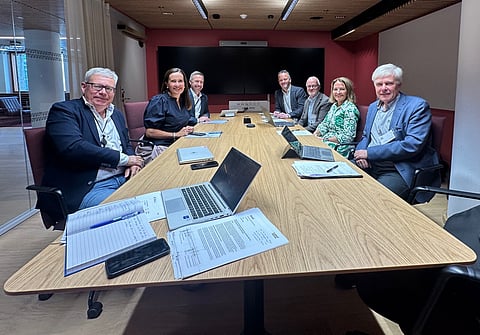


From left: Head of Expedition at NFD, Yngve Torgersen, Minister Marianne Sivertsen Næss, State Secretary Even Sagebakken, Sjømat Norge CEO, Geir Ove Ystmark, Sjømat Norge Deputy Chair and Head of the Aquaculture Industry Group, Øyvind Oaland, Sjømat Norge Board Chair, Line Ellingsen and Director of Aquaculture at Sjømat Norge, Jon Arne Grøttum.
Photo: Seafood Norway

The Norwegian Seafood Federation Sjømat Norge has submitted a package of proposals for reforming Norway’s aquaculture regulations, arguing that future rules should be based on updated evidence and designed to remain effective over time.
The organisation presented its recommendations to Fisheries and Ocean Policy Minister Marianne Sivertsen Næss on 9 July, following more than a year of internal work involving aquaculture companies and suppliers from across Norway.
Its proposals cover environmental regulation, fish welfare, spatial management and this year’s capacity adjustments under the traffic light system.
“The aquaculture industry needs a regulatory system that delivers better environmental results while supporting value creation, employment and development along the coast,” said Line Ellingsen, chair of the Norwegian Seafood Federation.
“To achieve that, regulations must be based on up-to-date knowledge and directed towards measures that actually work.”
The Federation said the government should carry out a broad assessment of the relationship between aquaculture and wild salmon before introducing further changes to the regulatory system. It also wants greater consideration to be given to the economic and social consequences of measures that reduce production.
Øyvind Oaland, deputy chair of the Federation and chair of its aquaculture industry group, said the government should avoid rushing into new rules.
“The government should therefore prioritise a broad assessment of the interaction between aquaculture and wild salmon. New regulations must be properly targeted,” he said.
The Federation is also asking the government to suspend further capacity reductions in red production areas until updated evidence and a new regulatory framework are available.
A central part of the package is the creation of a nationwide environmental flexibility scheme.
Last October, the Norwegian government announced an "environmental flexibility" incentive scheme designed to speed up the shift towards closed containment aquaculture. The policy, brought in by the Ministry of Trade, Industry and Fisheries, gives fish farmers a chance to regain production capacity lost through the traffic light system, as long as the fish are raised in closed systems that meet specific environmental standards.
The move followed the Norwegian parliament's approval last summer of aquaculture policy updates originally proposed in April 2025.
However, Sjomat Norge and other industry representatives such as Sjomatbedriftene have criticised the scheme, arguing that it lacks sufficient technological flexibility, limits innovation and contradicts the intentions of Parliament.
Instead, the Federation proposes a "technology-neutral" system, and would seek to encourage lower sea lice output and faster adoption of measures that improve environmental performance.
The Federation said such a scheme could be introduced during the transition to a new regulatory model.
“We believe environmental flexibility can deliver environmental improvements more quickly while the knowledge base concerning factors affecting wild salmon is reviewed and the new regulatory framework is developed,” said aquaculture director Jon Arne Grøttum, describing it as “a more targeted measure than broad, general capacity restrictions.”
Oaland emphasised the choice of technology or production method should not determine eligibility.
“The decisive factor is not which technology or operating method is used, but whether the solutions are cost-effective and feasible,” he said.
The Federation has also called for responsibility for aquaculture administration to be consolidated under the Norwegian Directorate of Fisheries.
It said the current system is divided between several authorities, contributing to slower decisions and less consistent consideration of environmental impacts, fish welfare, area use and economic activity.
“The current administration is too fragmented. A single aquaculture authority would provide clearer responsibility, faster case processing and better overall assessments of environmental impacts, fish welfare, spatial use and value creation,” said chief executive Geir Ove Ystmark, reiterating remarks he made on the subject in May this year.
The organisation said the Directorate of Fisheries would need decision-making powers for the reform to replace the existing structure effectively.
The package also proposes the introduction of rolling company-level maximum allowed biomass, or MTB. According to the Federation, the change would give producers more flexibility while allowing environmental performance, fish welfare and production to be considered together.
The organisation has also urged the government not to introduce a levy linked to fish mortality.
“The industry shares the authorities’ goal of improving environmental performance and fish welfare. At the same time, the measures must be properly targeted,” Ystmark said.
“Regulations must provide incentives for documented improvements rather than weakening investment capacity or creating unnecessary uncertainty.”
The Norwegian Seafood Federation described its meeting with the minister as "constructive" and said it would continue to contribute to the government’s work on the future regulatory system.
“We believe there is broad agreement on the objectives,” Ellingsen said. “Our message is that the route towards them must be based on knowledge, properly targeted measures and an administrative system that makes it possible to continue improving the industry.”
