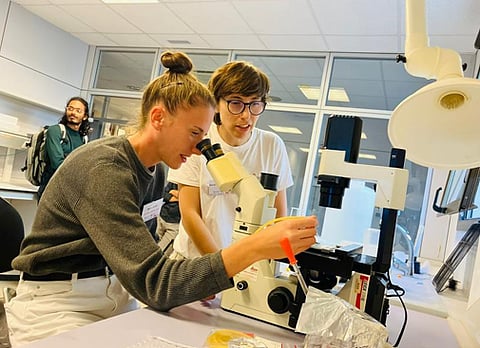


First training on restorative aquaculture at the Mediterranean Restorative Aquaculture Demonstration Centre in La Ràpita, Spain.
©FAO-GFCM/Georgios Paximadis

The General Fisheries Commission for the Mediterranean (GFCM) of the Food and Agriculture Organization of the United Nations (FAO) highlights recent developments and ongoing initiatives aimed at tackling the major challenges facing fisheries and aquaculture in Algeria, France, Italy, Morocco and Spain.
In recent years, the GFCM has focused on the recovery of blackspot seabream stocks, combating illegal, unreported and unregulated (IUU) fishing, strengthening fisheries science through the MedSea4Fish capacity-development programme, reducing and mitigating seabird bycatch, and promoting restorative aquaculture and aquatic animal health across the western Mediterranean.
According to The State of Mediterranean and Black Sea Fisheries 2025 report, the western Mediterranean accounts for the second-highest volume of landings, representing nearly 20% of the GFCM area of application. The subregion also leads in terms of revenue and ranks among those with the highest levels of fisheries employment within the GFCM.
The GFCM's work is supported by its Western Mediterranean Technical Unit in Málaga, Spain, and made possible through financial contributions from the European Union, its main donor, as well as support from the Global Environment Facility (GEF) and the Government of Spain.
One of the GFCM’s most successful initiatives has been the MedSea4Fish programme, which promotes stronger science and closer cooperation between scientists and fisheries administrations across the Mediterranean.
The programme supports the monitoring of discards and bycatch of vulnerable species, as well as research on European eel (Anguilla anguilla), red coral (Corallium rubrum), recreational fisheries, and blue crab species (Callinectes sapidus and Portunus segnis).
"These initiatives are providing a solid scientific basis for more effective, ecosystem-based and science-based fisheries management, while also supporting the sustainability of fisheries and the livelihoods of fishers," said Mohammed Malouli Idrissi, Scientific Coordinator of the MedSea4Fish programme in Morocco.
One of the most positive outcomes is that the western Mediterranean has become the leading subregion in terms of the number of assessed stock units, increasing from 26 in 2008 to 65 in 2023. Moreover, Spain and Italy have recorded the greatest increases in assessment coverage, particularly since 2018.
In other developments, Abderrahmane Hentour, Director of Monitoring and Technical Support for Fisheries and Aquaculture Activities at the Ministry of Agriculture, Rural Development and Fisheries of Algeria, announced the launch of an acoustic survey at sea to assess the abundance of pelagic fish and collect "crucial" information.
In line with these policies, the GFCM and the Department of Agriculture, Livestock, Fisheries and Food of the Government of Catalonia inaugurated the Mediterranean Restorative Aquaculture Demonstration Centre in La Ràpita, Spain.
The centre held its first training course on techniques supporting restorative aquaculture practices in October 2025. Ten experts from seven countries took part in the training, which focused on the farming of bivalves, seaweed, and grey mullet.
"Through discussions with colleagues across the Mediterranean, we realised that many of the challenges we face are shared: rising water temperatures, sudden mortality events, and non-indigenous species. By pooling knowledge and working together, we can accelerate solutions, build on collective experience, and strengthen responses across the region," said Enric Gisbert, Head of the Aquaculture Programme at IRTA.
Finally, it is worth noting that the GFCM organizes training sessions for inspectors to strengthen national capacities in monitoring, control, and surveillance (MCS), including the use of innovative technologies such as drones to detect IUU fishing activities.
