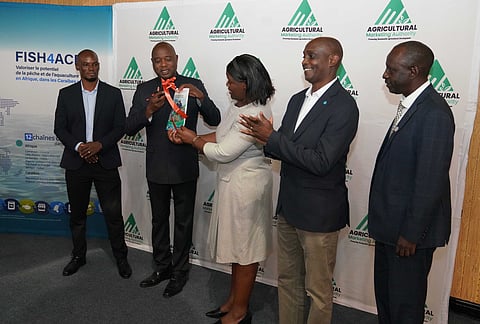


Honourable Davis Marapira, Zimbabwe's Deputy Minister of Lands, Agriculture, Fisheries, Water and Rural Development, officially launching the strategy.
Photo: FAO / Kevin Mazorodze

Zimbabwe has launched its first marketing strategy for farmed tilapia, in a move the government and its partners say could help develop aquaculture into a more significant source of food and income.
The strategy was unveiled in Harare on 24 March and was developed with support from the Food and Agriculture Organization of the United Nations (FAO) under its FISH4ACP programme, in collaboration with the Zimbabwean government and the Agricultural Marketing Authority.
According to FAO, the strategy sets out a framework for improving tilapia production, developing more structured markets and encouraging greater value addition in the sector, while also seeking to cut dependence on fish imports. The strategy was developed with stakeholders from the aquaculture sector, following research and consultations in Manicaland and Harare provinces.
Patrice Talla, FAO subregional coordinator for Southern Africa and representative to Zimbabwe, called the launch "the beginning of a new journey in Zimbabwe’s aquaculture sector," and described the strategy as "an accelerator, bringing together evidence, market insights, and stakeholder ambitions to chart a bold, coordinated path forward.”
Speaking at the launch, deputy minister of Lands, Agriculture, Fisheries, Water and Rural Development Davis Marapira said the plan offered “a clear roadmap for development of a viable Tilapia Value Chain that will positively contribute to the country’s economic development”. He added that its success would depend on coordination, saying the government would continue to support the sector through policy support and extension services.
According to a news release by the FAO, the strategy focuses on improving access to quality fingerlings and feed, promoting better farming practices, and upgrading cold chain systems. It also calls for stronger quality assurance and traceability, while encouraging more locally processed tilapia products and branding aimed at raising the profile of Zimbabwean fish.
The plan also places emphasis on inclusion within the sector. Barbara Muyengwa, head of marketing and public relations at Zimbabwe Women’s Microfinance Bank, said the strategy created opportunities for women involved in the tilapia value chain.
“Women already play crucial roles in the tilapia value chain, and this strategy creates the financial pathways, training platforms and market opportunities they need to scale up their enterprises and fully participate in the blue economy,” she said.
FAO said the strategy also gives the Agricultural Marketing Authority a central role in market development and called for stronger cooperation between public and private sector participants involved in aquaculture.
FISH4ACP is led by the Organisation of African, Caribbean and Pacific States and implemented by FAO with funding from the European Union and Germany’s Federal Ministry for Economic Cooperation and Development. The programme aims to support fisheries and aquaculture value chains in Africa, the Caribbean and the Pacific.
