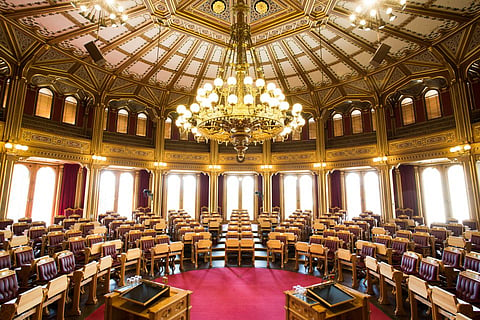


Interior of the Storting, Norwegian Parliament in Oslo, where the elimination of the aquaculture Price Council was voted on last week.
Photo: Storting.

Last week, as Norway prepared to abolish the controversial aquaculture Price Council, while proponents of its removal argued that the change would bring greater predictability to aquaculture businesses, critics warned that it could favour large, vertically integrated producers. Ultimately approved by 54 votes to 47, the decision by the Storting (Norwegian Parliament) leaves the Government back at square one regarding the resource rent tax on aquaculture—the so-called "salmon tax"—: how to set reference prices.
Specifically, the summary of the decision published on the Storting website reads as follows: "The Parliament has considered a proposal from the Conservative Party (Høyre) to abolish the aquaculture Price Council. Parliament decided to request that the Government present a proposal to abolish the standard pricing system and the aquaculture Price Council (the standard pricing council), with effect from the 2027 tax year."
So far, the Norwegian Government has not commented on what its next steps will be.
Until now, the Price Council, an independent body appointed by Norway's Ministry of Finance, has set binding prices for salmon, trout, and rainbow trout producers, which were used to calculate the resource rent tax on aquaculture. It did so using reported sales data from producers, company input and wider market information.
In contrast, the proposal for its elimination, now approved in the Storting, calls for the aquaculture tax to be determined based on actual market prices, in a way equivalent to corporate taxation.
With slight variations, the argument put forward by the winners of the vote during the preceding parliamentary debate suggested that both the resource rent tax and the Price Council represent an unnecessary bureaucratic burden and an unreasonable way of taxing the sector. Taxes should be paid on actual income, not on theoretical amounts, they said.
In their opinion, the aquaculture Price Council has created uncertainty about the reference price and, consequently, about the final tax, making it difficult for the companies to plan, invest and enter into long-term agreements.
In their speeches, most—both those against and in favour of abolishing the Council—referred to small and medium-sized producers, who in practice have been most affected by the new system, which was introduced in May 2024, after the Norwegian Parliament finally reached an agreement to set it at 25%.
Many pointed out that, since its implementation, the consequence of this policy decision is that small and medium-sized aquaculture companies are being acquired by larger companies, which have far more resources to cope with the new tax regulations and the increase in bureaucracy, achieving the opposite of what the Government promised.
An example of this could be the case of Nova Sea. In its consultation response to the proposed tax—back in December 2022—the salmon company said the problem wasn't paying more, but how the amount to be paid was defined. Just three years later, Mowi received approval from both the EU Commission and the Norwegian competition authority to become the majority owner of Nova Sea. The transaction was completed in March 2026.
Thereby, while, beyond the argument of bureaucracy, Geir Pollestad, representative of the Centre Party (Senterpartiet - SP), justified his party's change of mind regarding the Price Council—it was one of the forces that initially supported it—saying that in practice it has contributed "to the unfortunate structural change and wave of acquisitions seen in the aquaculture industry," another parliamentarian, Ingrid Fiskaa, of the Socialist Left Party (Sosialistisk Venstreparti - SV), made a direct allusion to Mowi.
In her speech, Fiskaa mentioned that, despite the salmon tax, in Q1 2026, Mowi had reported an operating profit of NOK 2.5 billion and record revenues of NOK 17.6 billion. "SV agrees with those who have criticized the design of the tax. That design has led companies to adapt to contribute as little as possible to the common good," she said.
As mentioned above, while virtually all parties have agreed that the introduction of the Price Council as an instrument to calculate the base on which to set the resource rent tax is not working in reality as it worked on paper for small and medium-sized businesses, in the case of large companies, the positions have been different.
While critics of the Council largely avoided discussing the issue, the behaviour of large integrated companies has been the most frequently cited argument by those in favour of maintaining it. Prime Minister Jens Stoltenberg himself referred to both SMEs and large corporations.
"I see several disadvantages with a resource rent tax without a Price Council," he said. "The tax may become less fair," he continued. "Because large, integrated companies have the ability to adapt, they will more easily obtain lower taxes, while smaller companies do not get this advantage. Abolishing norm prices may therefore reinforce the development toward a more concentrated industry, where only a few large companies remain."
"We are aware of the dissatisfaction. It is not new that people who pay taxes, and especially actors who pay resource rent tax, are dissatisfied with it," Stoltenberg said later.
However, he also insisted that the opportunities both to shift income away from the offshore operations and onto the onshore operations, and thereby reduce the profit where resource rent tax applies, or to shift costs into the offshore operations and thereby reduce the profit subject to resource rent taxation, are much greater in an integrated company that has slaughterhouses, wellboats, and many other services, which precisely makes it easy to move income out and costs in.
"That option is not available to smaller companies. Therefore, the tax will become more unfair if we do not have a norm price," the Prime Minister concluded. In his view, eliminating the Price Council will reduce tax revenue for the community and, furthermore, would contribute to a more complex system, with more reporting and more bureaucracy.
As WeAreAquaculture reported, before the vote, most of the industry's representative associations had already expressed their support for abolishing the Price Council. However, following the vote, Sjømat Norge, the Norwegian Seafood Federation, issued a new statement in which its CEO, Geir Ove Ystmark, affirmed that the decision was correct and long-awaited, while rejecting claims that it was an attempt to avoid taxation.
"The Storting has cleaned up a failed system." With that headline, the CEO of Sjømat Norge summed up the sentiment of the sector. "The Storting's decision to abolish the Norm Price Council is correct," he continued. "The aquaculture Price Council is a model taken from petroleum and hydropower, which has been forced into an industry that is fundamentally different."
"Here, the resource rent tax is isolated to value creation in the marine phase. Resource rent in aquaculture is the only resource tax that starts in the middle of a value chain, and norm pricing is a theoretical average tax that tries to find a market price that does not actually exist," Ystmark said, explaining the federation's position.
He also used his statement to praise the majority in the Storting that made the decision, both the parties that maintained their previous position, such as Høyre and the Progress Party (Framstegspartiet - FrP), as well as the SP, which he said "has listened to the coastal industry and the regions and changed its position accordingly."
Ystmark also had a few words for those who, throughout the debate that arose both within the Norwegian Parliament and in the media, argued that the abolition of the Price Council would lead to aquaculture ceasing to contribute to the Norwegian "collective effort."
"This is a fundamentally incorrect description of what the Storting has actually decided," he claimed. "No tax rates are being changed. The aquaculture industry still pays 22% corporate tax and 25% resource rent tax, in addition to production fees, export fees, R&D fees, property tax on sea facilities, and auction prices for all licenses. What is happening is that a bureaucratic and failed system is being removed."
Sjømat Norge's CEO also responded to the criticism that companies will now be able to determine their own tax base, which would increase the risk of tax evasion and errors in tax returns. In his opinion, this argument turns reality upside down.
"Self-reporting is not the exception in the Norwegian tax system. It is the rule. The entire system, from ordinary wage earners to the largest industrial groups, is based on the taxpayer reporting their own figures under documentation requirements, audit possibilities, and criminal liability. Norm prices are the exception. That should of course also be the case for the aquaculture industry," Ystmark said.
Thus, in addition to emphasizing that self-reporting in line with established transfer pricing guidelines is not "tax trickery," he also refuted the argument that abolishing the Council would require an excessive amount of staff in the tax administration to monitor and investigate whether prices in the aquaculture industry are correct.
"It is a completely ordinary tool in tax law, used by businesses around the world. Any disagreement between the taxpayer and the Tax Administration about what the correct price is, is normal; it is not fraud. The Tax Administration has solid experience with this type of control. There is nothing that suggests aquaculture cannot be handled in the same way as all other industries," he stated.
The claim that abolishing the normative pricing regime benefits large companies and harms small ones was also refuted by Sjømat Norge. According to Ystmark, based on the feedback they have received and continue to receive from their members, it is actually almost the opposite.
"The weekly reporting regime has been resource-demanding for everyone, but it is the small and medium-sized Norwegian-owned companies along the coast that have carried the heaviest burden," he said. "They do not have large compliance departments. It is no coincidence that the breadth of the industry, and especially the smaller companies, have wanted the council abolished."
Before Sjømat Norge, and even before the vote, another relevant industrial body in Norway, Sjømatbedriftene, the association of Norwegian Seafood Companies, had already expressed its satisfaction with what was about to be decided in Parliament. "This is an important and necessary decision for the Norwegian aquaculture industry," said its CEO, Robert H. Eriksson.
Sjømatbedriftene said it now expects the Government to quickly and clearly follow up on the Norwegian Parliament's decision. "Our clear expectation is that the government will follow this up in the national budget and ensure that the will of the Storting is actually implemented. This is crucial for trust between the industry and the authorities," its CEO stated.
"We now expect the parliamentary majority to continue working to ensure framework conditions that contribute to greater competitiveness, more predictability, and a stronger willingness to invest in the seafood industry," Eriksson continued. "We certainly would not be unhappy if they also managed to agree on abolishing the current resource rent tax altogether," he added.
