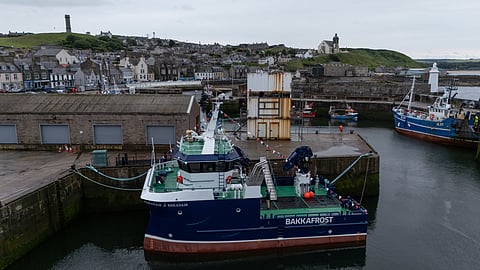


The Dìonadair a' Bhradain, meaning "Guardian of the Salmon", decked out for its launch at Macduff Shipyards in Aberdeenshire, Scotland.
Photo: Bakkafrost Scotland.

Scotland's Economy Secretary, Stephen Flynn—whose ministerial responsibilities include the promotion of the country's food and drink sectors—was in charge of launching Bakkafrost Scotland's new Scottish-built salmon vessel this week, which he named Dìonadair a' Bhradain, meaning "Guardian of the Salmon".
Built by Macduff Shipyards for Bakkafrost Scotland, the new vessel will play a key role in fish health and welfare, including essential wellboat operations on farms located along the west coast and islands.
"A Scottish vessel, built by a Scottish yard for a key Scottish industry is something that will be celebrated across our nation," Flynn claimed. "Our rural and coastal communities have been at the heart of Scotland's economy for centuries and investments like this help to ensure that the future is positive for local jobs and local skills."
This "Guardian of the Salmon"—its name, Dìonadair a' Bhradain, was chosen by 11-year-old Greg Sinclair, son of Donnie Sinclair, Bakkafrost Scotland's Head of Marine Operations—has a sister vessel, Bradan an Eòlais, meaning "Knowledge of the Salmon", which entered the company's fleet last year to support wellboats across the west coast and islands.
Valued at GBP 3 million, it is an 18.5-meter-long and 9.6-meter-wide catamaran that will reinforce the fleet of 87 vessels of Bakkafrost's Scottish branch, providing support to farms and collaborating with local suppliers in coastal and island communities across Scotland.
Built to meet the practical demands of marine aquaculture, the vessel includes cranes, winches and crew accommodations that support lifting work, preparing treatments and carrying out other tasks at the Scotland-based salmon farming company's sites.
Specifically, its design is intended to support work related to the health and welfare of fish at sea, while providing farm teams with a stable platform in the demanding conditions of the Scottish west coast.
"Dìonadair a' Bhradain reflects the close collaboration we've built with Bakkafrost Scotland over many years, delivering a vessel tailored to the practical demands of aquaculture," said John Watt, Managing Director of Macduff Shipyards.
"Dìonadair a' Bhradain is another major investment in fish health and welfare, giving our marine teams a highly capable vessel built around the realities of working at sea," commented, for his part, Ian Laister, Managing Director at Bakkafrost Scotland. "Our long-standing partnership with Macduff Shipyards is built on trust and a shared commitment to quality."
Aerial view of the Dìonadair a' Bhradain, showing the different elements included to support the work on board.
Photo: Bakkafrost Scotland.
In its press release announcing the launch of the new salmon vessel, Bakkafrost highlighted that this GBP 3 million investment is part of its commitment to local sourcing and manufacturing in Scotland, contributing to the development of a more resilient supply chain that benefits coastal and island communities.
In fact, the company recently announced a further GBP 4.4 million package of marine work with Scottish yards, including a new GBP 3.5 million contract with Macduff Shipyards for another heavy-lift workboat to support wellboat operations and a barge refurbishment project with Bute Boat Builders, which in April already delivered a new GBP 1.2 million landing craft for its farm sites in Loch Striven, Argyll and Bute, and Arran.
"Continued investment in Scottish yards is good for our business, good for fish health and welfare, and good for the skilled supply chain and coastal communities that support aquaculture," Laister said, commenting on the collaboration with Macduff Shipyards.
The opening follows an investment of more than GBP 11 million by Bakkafrost Scotland in the Aberdeenshire shipyard for a number of vessels, supporting around 250 jobs and 40 apprenticeships.
"Long-term investment from companies such as Bakkafrost Scotland gives yards like ours the confidence to invest in people, apprenticeships and capability. It supports highly skilled jobs across the north-east and strengthens Scotland's marine supply chain," John Watt stated.
Macduff Shipyards operates shipyards in Macduff, Buckie and Fraserburgh, so its managing director added that they hoped the Chancellor's visit for the launch of the salmon vessel would also serve to highlight the important contribution that shipbuilding continues to make to coastal communities and the Scottish economy as a whole.
From left, Scotland's Economy Secretary, Stephen Flynn; Managing Director of Bakkafrost Scotland, Ian Laister; and Managing Director of Macduff Shipyards, John Watt.
Photo: Newsline Media Ltd. / Bakkafrost Scotland.
Salmon Scotland, the trade body representing the Scottish salmon sector, also commented on the opening, noting that it comes at a time when its members and companies in their supply chain continue to invest millions of pounds in new vessels and marine infrastructure.
As an example, it cited recent vessel construction and refit projects involving not only Bakkafrost Scotland but also Inverlussa Marine Services, Scottish Sea Farms, Mowi Scotland, and Cooke Aquaculture Scotland.
According to the trade body, all these jobs not only support skilled employment in the shipbuilding, design, engineering and coastal economy sectors, but also highlight the important role that salmon farming plays in strengthening the country's maritime supply chain, including the specialized shipbuilding and design expertise of northeast Scotland.
"Scotland's Economy Secretary is today recognising the investment being made by the salmon sector and the skilled jobs it supports," said Salmon Scotland's CEO, Tavish Scott. "That is very welcome and an indication that the new Cabinet Secretary sees his role as encouraging the food and drink sector to grow Scotland's economy."
"Today's vessel naming is about much more than one boat. It shows how salmon farming creates opportunities far beyond farms and processing sites, sustaining jobs in shipbuilding, marine design, engineering and the wider supply chain," he continued.
"When salmon farming grows, shipyards, suppliers and coastal communities grow with it. This is exactly the kind of home-grown economic growth Scotland should be backing, with businesses investing in the skills and jobs that keep our country thriving," Scott concluded.
