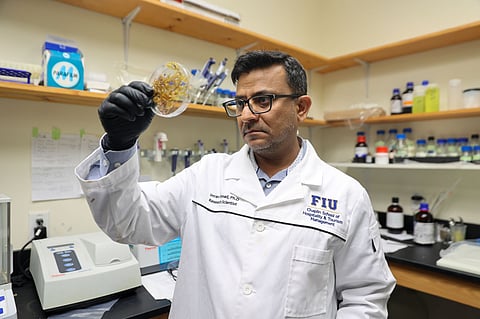


Food science and technology research professor, Dr Imran Ahmad, with a sample of waste sargassum.
Photo: Florida International University

As large quantities of sargassum seaweed continue to pile up on Florida's beaches, researchers at Florida International University are studying whether the biomass could be used as a food-grade ingredient rather than treated only as waste.
The university said findings recently published in Food Hydrocolloids indicate that sargassum may be a useful source of alginate, a natural polysaccharide used to thicken and stabilise products including ice cream, sauces and dairy alternatives. The study was carried out in collaboration with researchers from Florida State University and Florida Atlantic University.
Sargassum, a brown algae that forms large blooms in the Atlantic, regularly washes up on beaches in South Florida, disrupting coastal ecosystems and requiring expensive clean-up work.
“The usual approach has been, 'How do we get rid of it?' We wanted to ask a different question: 'Can we use it for something valuable?'” said Imran Ahmad, a food science and technology research professor in FIU’s Chaplin School of Hospitality & Tourism Management and a co-author of the study.
According to FIU, the researchers found extraction yields of about 45%, suggesting the seaweed could be an alternative source of alginate to seaweeds that are currently harvested for commercial use.
The work remains at an early stage. Sargassum is not currently classified as a food source and may contain contaminants, so the researchers are also examining how it could be processed safely.
“It's generally treated as waste because it smells, affects tourism and can carry contaminants or bacteria,” Ahmad said.
The team is looking at techniques including high-pressure processing, a method already used in parts of the food industry, to reduce microbial risks while retaining compounds that could be useful.
“Instead of using heat, which can damage nutrients and structure, we apply extremely high pressure,” Ahmad said. “That high pressure kills harmful microorganisms but preserves the useful compounds we want to extract.”
FIU said researchers have identified and extracted key compounds and are now refining processing methods and assessing possible uses. Any consumer product would still need further testing and regulatory approval.
“Our researchers at the Chaplin School are always looking for ways to solve problems that affect and can help improve the hospitality and tourism industry,” said Michael Cheng, dean and professor at the school. “We are proud of Dr. Ahmad's innovative research and look forward to seeing how his work can help solve not only a Florida, but much larger global issue.”
The university said the research could help reduce waste and clean-up costs if sargassum can be turned into a usable resource. For now, the findings suggest a possible use for a recurring coastal problem rather than an immediate commercial solution.
“If we can turn it into something useful, we shift the conversation from disposal to opportunity,” Ahmad said.
