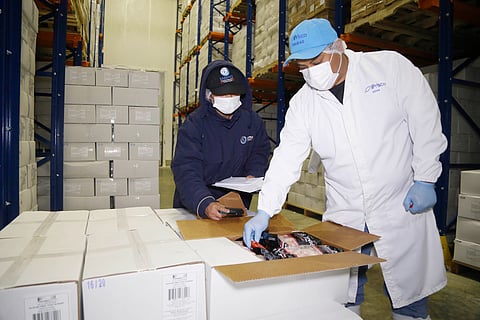


A Sanipes official inspecting the storage facilities of the Peruvian seafood company iPrisco.
Photo: Renato Candiotti / Sanipes.

During the first quarter of 2026, the Peruvian National Authority for Sanitary Certification in Fishing and Aquaculture (Sanipes) issued a total of 7118 sanitary certificates for seafood exports, which, according to Peru's Ministry of Production (Produce), allowed 194 Peruvian companies to place 597,201.91 metric tons of hydrobiological products abroad.
With 2,488 additional certificates, the figure represents a growth of 53.74% compared to the same period in 2025. Produce pointed out that this number of certificates reaffirms the country's greater capacity to respond to international demand with products that rigorously comply with the health and safety standards required by destination markets.
"This result demonstrates that the Peruvian fishing and aquaculture sector continues to strengthen its international competitiveness based on quality, traceability, and sanitary compliance," said Peru's Vice Minister of Fisheries and Aquaculture, Jesús Barrientos, commenting on the figures.
"Each certificate represents a concrete opportunity for more Peruvian companies to reach the world with safe, high-value products," he added.
"International markets' confidence in Peruvian seafood products is based on serious and ongoing technical work," said, for her part, Mónica Saavedra, Executive President of Sanipes.
"At Sanipes, we will continue to strengthen the efficiency of certification processes to support the country's export growth," she added.
Thus, in line with the Ministry of Production's policy of strengthening the competitiveness and sustainability of the sector, the health certifications issued by Sanipes—an entity attached to Produce—guarantee that the hydrobiological and aquaculture products exported by Peru meet the requirements demanded by the destination countries, facilitating their commercial access and protecting public health.
According to Produce's statement, from January to March, the main products exported under that certification were jumbo flying squid, anchovy, jack mackerel, prawns and scallops, while the markets that led the demand were China, Spain, South Korea, Thailand and Japan.
In total, these exports reached a value of USD 1.2 billion FOB—this is 'Free On Board', which represents the cost of the goods at the point of shipment or loading, excluding insurance and freight costs. Peruvian seafood exports thus continue to show strong performance in international markets.
Regarding the outlook for this year, Produce stated that the projection maintains an upward trend. Sanipes estimates reaching 14,847 certifications by the end of the first half of the year and 26,174 by the end of 2026, surpassing the 25,536 export health certificates issued in 2025, a year declared as a "turning point" for national fisheries health and artisanal fishing.
In other words, according to figures from the Ministry of Production, growth of around 2.5% is expected this year. This figure becomes even more significant considering that, as reported by WeAreAquaculture, health certifications for hydrobiological products skyrocketed in Peru last year.
Thanks to the health certificates issued by Sanipes, a total volume of 1,907,244.5 metric tons of fishing and aquaculture products was exported in 2025, with a value of USD 4.1 billion FOB.
Among the main products exported were fishmeal—in an average year, Peru accounts for around 20% of global production of both fishmeal and fish oil—frozen jumbo flying squid and frozen shrimp, as well as fresh and frozen jack mackerel, which last year accounted for most of the volume and value of exports backed by these certifications.
Moreover, in line with certification and compliance with international health and sustainability regulations, in 2025, Peru ensured the continuity of its mahi-mahi exports to the U.S. by approving a set of measures to comply with the environmental standards required by the US Marine Mammal Protection Act (MMPA), and it also passed a decree to amend the Marine Macroalgae Fishing Regulations to strengthen sustainability and improve the traceability of this resource.
