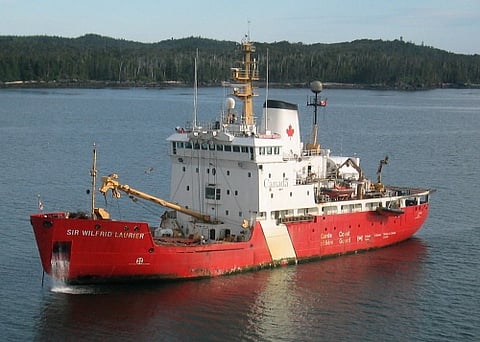


The Canadian Coast Guard Ship, Sir Wilfrid Laurier.
Photo: DFO Canada

Canada is carrying out a two-month patrol in the North Pacific targeting illegal, unreported and unregulated fishing.
The latest Operation North Pacific Guard mission began in June, with Fisheries and Oceans Canada officers due to cover more than 15,000 kilometres of international waters aboard the Canadian Coast Guard Ship Sir Wilfrid Laurier.
During the patrol, officers will board fishing vessels, inspect their operations and check compliance with international fisheries rules.
The Canadian mission is being supported by the Canadian Coast Guard and the Royal Canadian Mounted Police, alongside representatives from the US Coast Guard, the US National Oceanic and Atmospheric Administration, Japan’s Fisheries Agency and the Republic of Korea Coast Guard.
Canada has also stationed a long-range surveillance aircraft in Hokkaido, Japan, to conduct daily aerial patrols and assist partner countries. Previous flights have identified possible breaches involving shark finning, dolphin harpooning, salmon retention, pollution and vessel-marking requirements, authorities said.
A total of 19 Canadian fishery officers are taking part in this year’s operation. Four are involved in the aerial surveillance programme in Japan, while another officer will join a Japanese patrol vessel as a ship rider.
Funded through Canada’s Pacific Salmon Strategy Initiative, the patrol has a scientific role as well as an enforcement one. Officers will collect environmental data and water samples for analysis in Canada and Japan, including work on Pacific salmon migration and microplastic levels in the North Pacific.
“Healthy fish stocks are crucial for food security, economic resilience, and the livelihoods of coastal and Indigenous communities in Canada, and around the world,” said Fisheries Minister Joanne Thompson.
“Through Operation North Pacific Guard, Canada is advancing responsible stewardship as a trusted convening partner to combat illegal and unsustainable fishing practices and support the long-term sustainability of our oceans.”
Canadian officers have participated in the annual operation since 2019, the Canadian Department of Fisheries said.
The patrols help enforce the United Nations ban on high-seas driftnets and monitor compliance with rules set by regional fisheries management organisations. Suspected violations are then referred to the relevant flag state for investigation, while serious cases can also be considered by international fisheries bodies, with sanctions potentially including fishing bans.
