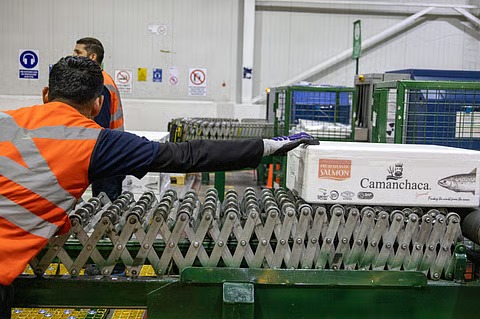


The U.S. is Chilean salmon's most important market, receiving more than 40% of its shipments.
Photo: Camanchaca.

It didn't work out. Despite the efforts of Chile and, in particular, the industry association SalmonChile to persuade the United States Trade Representative (USTR) to include Chilean salmon in Annex A—the exemptions reserved for products for which there is no sufficient domestic substitute in the U.S.—rather than in Annex B, which is subject to a 12.5% tariff, Chile's second-largest export last year has ultimately not been spared.
As reported by WeAreAquaculture, in early June, the USTR concluded that 60 economies do not prohibit—or fail to prohibit—the importation of products manufactured wholly or partially through forced labor and, on this basis, recommended the imposition of a new general tariff of 12.5% that would affect Chile, among other countries. A period for submitting arguments was then opened so that those affected could present their case, which would later be considered by the USTR. Yesterday, all of that ended.
"Today's action comes after the Office of the United States Trade Representative's investigations, which included two rounds of public hearings, more than 2,100 public comments, and engagement with our trading partners to remedy these longstanding concerns," read the USTR statement.
On behalf of President Trump, the US trade representative, Ambassador Jamieson Greer, announced the imposition of tariffs on 60 economies "for their failure to impose and effectively enforce a prohibition on the importation of goods produced with forced labor."
"President Trump recognizes that decades of moral suasion have not eradicated forced labor from global supply chains. The United States has had a forced labor import ban for nearly a century, and rigorously enforces it; it’s well past time for our trading partners to do the same," Greer said.
"Today's action will begin to correct what is both a human rights abuse and distortive trade practice to improve the welfare of workers everywhere. I am encouraged by the trading partners who have moved quickly to adopt forced labor import prohibitions, and look forward to ensuring their effective enforcement," he added.
As for Chilean salmon, the announcement confirmed that, from today, it will face a 12.5% tariff, a hard blow considering that the U.S. represents its most important market, receiving more than 40% of its shipments.
At the moment the USTR included Chile among those 60 economies "suspected" of not prohibiting—or failing to prohibit—the importation of products manufactured wholly or partially through forced labor, SalmonChile's immediate priority was to travel to Washington D.C. to participate in the USTR hearings, scheduled for Tuesday, July 7, and explain firsthand why Chilean farmed salmon should be excluded from that general tariff and included in the aforementioned Annex A.
SalmonChile's focus during the presentation was strictly technical, putting forward three main arguments:
There are no local competitors in the U.S. for Chilean salmon. Local US supply comes mainly from wild-caught salmon in Alaska, a niche seasonal product that does not compete with Chilean farmed salmon, which guarantees a massive, stable and affordable supply throughout the year.
The value of economic complementarity between the two countries. While salmon is the main driver of Chilean non-mining exports, it also supports a processing network in several U.S. states, generating more than 1,200 direct jobs on US territory. Likewise, the development of aquaculture in southern Chile represents an important demand hub for US suppliers of biotechnology, pharmaceutical services and specialized inputs.
It is a key piece in the 'Make America Healthy Again' (MAHA) agenda. The food pyramid inspired by the MAHA movement inverts the traditional model, placing quality proteins, healthy fats, and vegetables at its base, which puts salmon at the top or main section. Therefore, from a public health perspective, salmon is a fundamental element, being a nutrient-rich protein and a source of omega-3 fatty acids.
In short, what SalmonChile and its President, Patricio Melero, tried to demonstrate to the USTR was that Chilean salmon is a strategic ally for US food security, so the imposition of new tariffs would not translate into protection for the US industry, but into a direct cost for its consumers.
The decision announced yesterday by the USTR thus confirmed that all the work done and all the arguments put forward by SalmonChile were in vain. "We regret this unilateral decision, which responds to a global resolution that transcends Chile and affects various productive sectors of our country," the trade association said in a statement issued immediately after learning the news.
"Given that the United States does not produce salmon and there is no reason to apply the tariff, our expectation was that Chile would not be included in this measure and, in particular, that Chilean farmed salmon would be added to Annex A and, therefore, exempt from a new tariff, considering the characteristics of our product and its importance to the US market," it continued.
SalmonChile added that, as an industry association, it will continue to insist on its request not to be subjected to a tariff increase and on the need for salmon to receive the appropriate treatment.
"Chile is a strategic supplier for the United States, and our product represents more than 40% of the salmon consumed by US people, so this measure could also end up affecting a trade relationship that has been beneficial for both countries," it emphasized once again.
The trade association concluded its statement by calling on the Chilean Foreign Ministry to exhaust all avenues and continue working with US authorities to find spaces for dialogue that would allow this decision to be reversed and move towards future tariff reductions.
Until now, Chile had been one of the salmon-producing countries best positioned after the application of the Trump Administration's protectionist policies—which the US President dubbed 'Liberation Day' while many considered it a declaration of trade war to the world—with a 10% tariff.
Among them, only Canada—which meets the requirements of the United States-Mexico-Canada Agreement and was therefore exempt—was in a better position, since Norway had a 15% tariff—which, after being overturned by US courts, was reduced to 10%—and the UK was in the same situation, at 10%. The decision announced yesterday by the USTR has broken that parity with the UK, although, for the moment, it remains the same with Norway, which must also face a 12.5% tariff.
