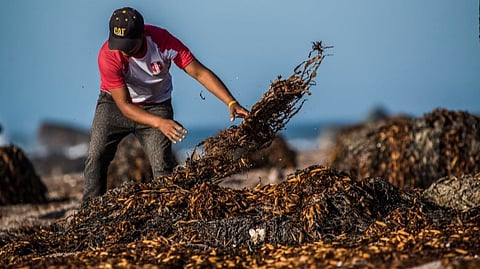


The study sets out a roadmap prioritizing the species Macrocystis pyrifera, known as giant sargassum.
Photo: Produce.

Conducted by Peru's Ministry of Production (Produce), Fundación Chile (FCh - Chile Foundation), and the World Bank Group, the study 'Value chain of algae in Chile, Peru and Ecuador' claimed that the future of Peruvian aquaculture should include the cultivation of macroalgae as an important activity, with enormous potential in the South American country.
According to its authors, Peru has the conditions to promote macroalgae farming, moving from an export of algae biomass to one of high added value with products such as biostimulants and food products.
The study by Produce, FCh and the World Bank identified four key points to take farmed seaweed to a higher level: enabling governance, technical-productive capacity, market development and financing and investment.
Thus, based on a rigorous analysis of the Peruvian algae sector's current situation, the study sets out a roadmap that prioritizes the species Macrocystis pyrifera, known as giant sargassum, a seaweed highly valued in organic agriculture, cosmetics and the food industry.
Specifically, its authors suggest focusing on two types of algae-based products: biostimulants, with a high probability of establishing themselves in the international market in the short term and incipient development in the Peruvian cities of Pisco and Marcona in the Ica region; and food products.
Regarding the latter, Produce highlighted in its note that macroalgae farming represents an opportunity for the animal feed market, since it constitutes a source of nutrients that favors the growth of aquaculture and livestock production.
Moreover, all of this is happening against a backdrop of growing global demand for natural and sustainable ingredients for various sectors, including poultry farming in Peru itself.
Furthermore, as part of this roadmap to promote its cultivation in Peru, the study highlighted the need to establish the macroalgae sector as a strategic growth priority for the country, strengthening the state-academia-market interaction, and promoting research and innovation.
The study—titled 'Value chain of algae in Chile, Peru and Ecuador', as mentioned above—concluded with a seminar. At the seminar, Rodolfo Espinoza, Managing Director of Aquaculture at the Vice-Ministerial Office of Fisheries and Aquaculture of the Ministry of Production of Peru, pointed out that the country has a privileged coastline and immense biological potential.
"The algae and macroalgae sector is a strategic pillar in our agenda for productive diversification and sustainability," he claimed, adding that the seminar marked a crucial closing milestone for consolidating technical analyses and outlining clear recommendations to boost its value chain. "These recommendations stem from a comprehensive mapping of opportunities," Espinoza added.
It's worth noting that shortly before the end of 2025, Peru's Ministry of Production approved a decree to amend the Marine Macroalgae Fishing Regulations, with the aim of strengthening the sustainable management of this marine resource. The changes sought to modernize the regulations for macroalgae artisanal and industrial processing and ensure traceability.
"Peru is a megadiverse country, and marine macroalgae play a fundamental role both in the balance of our ecosystems and in the economic development of thousands of families," Peruvian Minister of Production César Quispe Luján stated at the time of the announcement of those measures.
Now, during the closing seminar of the study, World Bank senior environmental specialist Maurice Rawlins expressed a similar view, highlighting the role of aquaculture in food security in Peru and the world.
"Peru is exceptionally positioned in the region with one of the world's most productive marine ecosystems, a rich tradition in coastal resource management, and a government committed to economic modernization. The conditions are ripe for building a truly competitive sector. And the seaweed sector is the kind of activity that fits within that broader vision," Rawlins stated.
