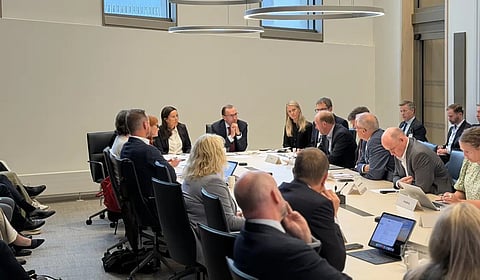


A moment from the meeting between the Norwegian Government and the business community regarding US tariffs.
Photo: Norwegian Ministry of Foreign Affairs (UD).

Following the new US tariffs announced at the end of July, Norway's Government—represented by Minister of Foreign Affairs Espen Barth Eide, Minister of Trade and Industry Cecilie Myrseth, and Minister of Fisheries and Oceans Marianne Sivertsen Næss—began its work after the summer break by meeting with representatives from the business community and labor market organizations to address the trade policy situation.
As WeAreAquaculture reported, on July 24, the U.S. announced new tariffs on products from 60 trading partners, including Norway and the European Union, following so-called Section 301 investigations into forced labor in supply chains. The U.S. trade officials alleged that Norway and the other countries do not have sufficiently effective prohibitions on the import of products manufactured using forced labor.
As the Norwegian Government recalled after this week's meeting, this means that the affected Norwegian products will be subject to an additional tariff of 12.5%, in addition to the ordinary tariff where applicable, while products from the EU will be taxed at a maximum tariff of 10%, including the ordinary tariff.
According to the Norwegian Government release, during the meeting, the ministers informed participants about the extensive contacts they have maintained with their US counterparts since the trade investigations against Norway began in March, submitting extensive written observations and maintaining close contact with US authorities at multiple levels. However, Norway's inclusion on that list of 60 countries has demonstrated that these efforts were in vain.
Norway—like Chile, a direct competitor in salmon exports to the U.S., which tried unsuccessfully to demonstrate to the United States Trade Representative (USTR) that Chilean salmon is a strategic ally for US food security—now faces a 12.5% tariff that puts it at a disadvantage compared to competitors such as the European Union and the UK—that is, Scottish salmon—which are subject to a 10% tariff, or the Faroe Islands, Greenland, and Iceland, which are completely exempt from tariffs because these countries have not been investigated.
Regarding this situation of inequality, in the release following the meeting with business leaders, the Norwegian Government expressed particular disappointment about the difference in treatment that the Trump Administration has given to Norway compared to the European Union.
"We strongly disagree with the United States' unilateral use of tariffs and the justification for them," said Norwegian Minister of Foreign Affairs Espen Barth Eide. "The Government has also made it clear to the U.S. authorities that Norwegian and European producers must be treated equally. Under the EEA Agreement, we will implement exactly the same forced labor legislation as the EU, at the same time as the EU."
"We have emphasized this message throughout the entire process," he continued. "We first did so in Norway's formal submission in April, and in our response of July 6 we wrote that 'Norway is committed to implementing the regulation by December 2027'," the Minister of Foreign Affairs added.
In the specific case of the seafood industry, this inequality between Norway and the EU has a double aspect since, apart from direct exports, it must be taken into account that much Norwegian salmon is processed in third countries, members of the European Union, and then exported to other countries such as the United States, thus receiving a lower tariff.
Thus, as mentioned above, Norwegian seafood exports were a central topic at this week's meeting. This is not surprising considering that, while exports to the United States will represent approximately 3.8% of total Norwegian merchandise exports, including oil and gas, by 2025 seafood exports will account for approximately 22% of those exports.
"The situation is challenging for seafood companies that have invested in the U.S. market and are now facing an unpredictable U.S. tariff policy. At the same time, the seafood industry has, over many years, demonstrated a strong ability to adapt and find new markets," said Norwegian Minister of Fisheries and Oceans Marianne Sivertsen Næss.
"This case also shows how important it is to secure market access in more countries in an increasingly unpredictable world. That is why the Government has prioritized work on market access and new free trade agreements, with seafood as a central focus," Minister Sivertsen Næss continued.
In its release, the Norwegian Government noted that, since taking office, it has concluded six new free trade agreements and that the seventh, with Vietnam—through the European Free Trade Association (EFTA)—will be signed this fall.
The meeting held this week also served as an opportunity for the Government to inform the Norwegian business sector about another ongoing US investigation concerning structural overcapacity in industry. The investigation covers Norway, the European Union, and 14 other trading partners, and could lead to new trade measures and further tariff increases.
The Norwegian Government explained that, in simple terms, structural industrial overcapacity means that a country's production capacity exceeds market demand. As WeAreAquaculture reported, both the Norwegian authorities and also the Norwegian seafood federation Sjømat Norge had already denied that there are grounds for imposing trade measures against Norway.
However, the national association for the Norwegian fishing and aquaculture industry also warned that the current US government's tariff policy puts Norway at risk of losing even more market share, a situation that could worsen if this new investigation concludes that Norway is not complying with the requirements.
"If this process were also to result in new tariff measures against Norway, the competitive disadvantage would be further exacerbated," Trond Davidsen, Sjømat Norge's Director of International Affairs, explained a couple of weeks ago, when the application of the 12.5% tariff was announced.
While awaiting the outcome of this new investigation—which, according to the release, will be known shortly—the Norwegian Minister of Foreign Affairs reiterated Norway's Government's position on the matter.
"We agree with the US authorities that global overcapacity is a problem, but we strongly reject the allegation that Norway pursues policies that contribute to it. Norwegian companies produce what the market demands. We have emphasized this in our contacts with the United States," Espen Barth Eide claimed.
Finally, in response to the uncertainty this situation poses for Norwegian exporting companies, the Norwegian Minister of Trade and Industry, Cecilie Myrseth, noted that the Government maintains close contact with the business sector, whose input is of great importance to its work with the US authorities.
"We will continue our dialogue with the Americans and clearly present our views on the new tariffs in order to secure the best possible competitive conditions for Norwegian businesses," Minister Myrseth concluded.
