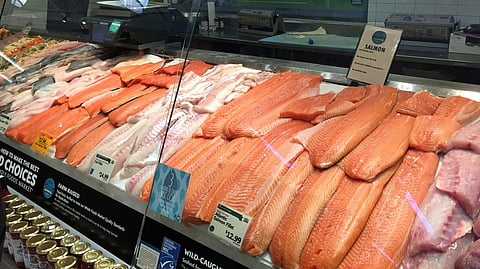


Fish counter with Norwegian salmon fillets in the U.S.
Photo: Trude Bessesen / Norwegian Seafood Council.

"Exports to the U.S. have already declined since the United States changed its tariff policy. With today's decision, we risk losing even more market share to competitors that enjoy better conditions than Norway." This was the stark assessment made last Friday by Geir Ove Ystmark, CEO of Sjømat Norge—the national association for the Norwegian fishing and aquaculture industry—after learning of the U.S. decision to impose a 12.55% tariff on Norwegian seafood exports.
As WeAreAquaculture has already reported, on July 23, under Section 301 of the Trade Act of 1974 and on behalf of President Trump, the United States Trade Representative (USTR) announced the imposition of tariffs on 60 economies "for their failure to impose and effectively enforce a prohibition on the importation of goods produced with forced labor."
The decision distinguishes between those who apply it and those who do not, but also between those who have tried to apply it unsuccessfully, and, depending on the level of compliance, the tariffs could be 12.5% or 10%. According to the USTR statement, Norway is among the 54 economies that have failed to impose and effectively enforce that prohibition and will therefore be taxed with the highest tariff.
However, while the U.S. justifies the new tariff based on its assessment of Norwegian regulations concerning products made with forced labor, Sjømat Norge—whose name can be translated as 'Seafood Norway'—considers that this assessment is unjustified and places the Norwegian seafood industry in a position of unfair competition in one of its most important single markets.
"Norwegian companies have zero tolerance for forced labor and are subject to the Transparency Act. Norway will also implement the EU's regulations banning products made with forced labor. We therefore see no basis for giving Norway poorer market access than our competitors," Ystmark said.
Despite being one of the most important individual markets for Norwegian seafood products, since the United States introduced country-specific tariffs last year, applying 15% to Norway and putting it at a disadvantage compared to other competitors such as Canada, the UK, Chile or the Faroe Islands, the value of exports began to suffer.
Although the U.S. Supreme Court later struck down the legal basis for these tariffs, leaving most countries subject to a uniform 10% tariff, the decline had already begun. And so, while 2025 began with the United States as the largest single market in the best January ever for Norwegian seafood exports, it ended with the US market as the second largest destination—the value of exports reached approximately NOK 16 billion—but with a downward trend.
Also exacerbated by an unfavorable exchange rate for the Norwegian krone, this downward trend intensified in the first half of this year. Thus, from January to June 2026, Norway exported seafood products to the U.S. worth NOK 6.3 billion. This represents a year-on-year decrease of NOK 2.4 billion, or 28%.
With the USTR's decision, Norway's access to the US market becomes even less favorable, not only because the tariff increases from 10% to 12.5%, but also because this change puts it in a less propitious position than several of its main competitors, especially salmon producers.
As Sjømat Norge noted in its release, while key competitors such as the European Union and the UK—that is, Scottish salmon—are subject to a 10% tariff, the Faroe Islands, Greenland, and Iceland are completely exempt from tariffs because these countries have not been investigated.
Meanwhile, in the northern part of the American continent, Canada is exempt thanks to the existing trade agreement with the United States for Canadian seafood products. In the south, Chile is the only direct competitor that is also subject to an additional 12.5% tariff—despite its efforts to avoid it by claiming that Chilean salmon is a strategic ally for US food security. However, Sjømat Norge stated that Norway is more affected because it exports a wider range of products to the US market.
In addition to this less favorable access for Norway compared to its competitors, while the European Union—where much Norwegian salmon is processed and then exported to other countries such as the United States—receives a lower tariff rate, there is an added disadvantage.
As Sjømat Norge reported, Norway is the subject of yet another US investigation, this time concerning state subsidies and overcapacity. Both the Norwegian seafood federation and Norwegian authorities have denied that there are grounds for imposing trade measures against Norway.
"If this process were also to result in new tariff measures against Norway, the competitive disadvantage would be further exacerbated," explained Trond Davidsen, Sjømat Norge's Director of International Affairs.
Thus, although the U.S. is one of the most important individual markets for Norwegian seafood products, the industry organization believes that the current situation highlights the need for more targeted efforts to improve access to other key markets that can provide an outlet for exports that, as a result of this tariff policy, will not be directed to the United States.
