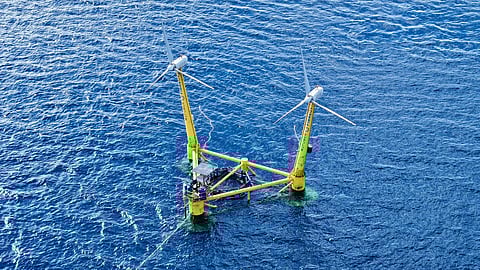


The AquaWind project, which combines offshore wind and aquaculture on a single floating platform, will be one of those that can benefit from the SIRENA 2 project.
Photo: AquaWind.

Under the name 'Comprehensive Remote System with new tools for Monitoring, Detection and Prediction of Risks of Potentially Harmful Marine Events of Natural or Anthropogenic Origin in Offshore Areas Destined for Aquaculture', the SIRENA 2 project, which will use artificial intelligence (AI) and autonomous marine technology to protect aquaculture in the Canary Islands, has started in Spain.
This scientific initiative continues the SIRENA project, which ended in early 2026, and will be developed between 2026 and 2027.
In this new phase, the objective will be to consolidate and expand the tools developed for the environmental monitoring of aquaculture facilities, increase their level of automation and facilitate their transfer to the productive sector, public administrations, the scientific community and society.
As the Spanish Aquaculture Business Association (APROMAR)—which contributes to the project in dissemination tasks—recalls in its note, the SIRENA project served to lay the foundations for a monitoring system based on remote detection using satellite images, the performance of oceanographic observations and the development of mathematical models to predict the transport of possible harmful events.
The new SIRENA 2 project will now delve deeper into these three main lines by incorporating artificial intelligence, automating processes, using new observation platforms, and developing remote communication systems for issuing alerts.
As said, this scientific initiative is geared towards the development of new technological tools to optimize the monitoring, detection and prediction of marine events, of both natural and anthropogenic origin, that may affect the offshore aquaculture farms of Gran Canaria, Canary Islands, Spain, and their marine environment.
The ultimate goal is to contribute to a more informed, resilient and sustainable offshore aquaculture, by providing tools that facilitate decision-making and the preventive management of environmental risks.
To optimize the automatic system for identifying environmental risks in the vicinity of farming areas, the SIRENA 2 project research team will use remote sensing images from the European Sentinel satellite constellation.
Through automated processing techniques, spatial segmentation and AI models based on deep learning, the system will be able to detect early critical phenomena such as potential harmful algal blooms (HABs), anthropogenic discharges—that is, of human origin—in open waters, or episodes of abnormal turbidity that compromise water quality.
This space-based observation will be complemented by on-the-ground measurements. In addition to traditional oceanographic campaigns, SIRENA 2 will integrate cutting-edge technology through the deployment of autonomous platforms, buoys, and unmanned surface vehicles (USVs) that will allow for the collection of high-resolution data on the environmental conditions of the marine environment.
All the information collected will be processed immediately to feed the mathematical models developed in the first phase of the project, which are responsible for predicting the evolution and displacement of threats, as well as for evaluating the interactions of aquaculture activity with the coastal ecosystem.
Data from satellites and observations made directly at sea will also be used by the SIRENA 2 project to apply high-resolution hydrodynamic models in areas near aquaculture farms in Gran Canaria, also helping to improve these models.
However, in addition to advancing the prediction of the possible impacts and trajectories of harmful marine events, the project also aims to generate automated early warnings that will improve the response capacity to risk situations.
Finally, and equally important, SIRENA 2 will also analyze the so-called ocean footprint of aquaculture activity, understood as how the activity interacts with the marine environment and the extent of that interaction. In this way, the system will not only study external events that may affect the facilities, but also the influence that the farms themselves can exert on their surroundings.
Coordinated by the Spanish National Research Council (CSIC), through the Institute of Mathematical Sciences (ICMAT-CSIC), the project also involves the University of Las Palmas de Gran Canaria (ULPGC), as well as the Oceanic Platform of the Canary Islands (PLOCAN), the latter of which also supports other projects such as the AquaWind project, which combines offshore wind and aquaculture on a single floating platform, or the company MACROCARBON, to develop algae farms in which the macroalgae Sargassum will be cultivated.
