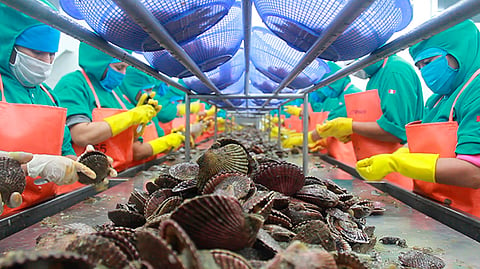


Scallops are one of the seafood products expected to benefit from the simplification of the inspection system.
Photo: Sanipes.

The Peruvian National Authority for Sanitary Certification in Fishing and Aquaculture (Sanipes) has launched a manual that transforms the traditional sanitary inspection model, enabling the implementation of a more predictive and intelligent surveillance system for the country's more than 400 authorized processing plants. With this new system, Peru aims to reduce sanitary inspection times at seafood processing by 45%.
The ultimate goal of this 'Manual for the Sanitary Inspection of Processing Plants within the Framework of Risk-Based Auditing' is to modernize sanitary inspection, strengthen food safety and boost exports of fishery and aquaculture products.
Commenting on this new approach, Mónica Saavedra, Executive President of Sanipes—an organization attached to Peru's Ministry of Production (Produce)—highlighted that "it allows us to close safety gaps and raise standards in the fisheries and aquaculture value chain."
Under the new inspection model and in collaboration with the sector's operators, Sanipes guides and prioritizes its actions based on the risks present in the facilities and/or systems intended for the processing of fishery and aquaculture resources and products, taking into account the nature and complexity of each phase of the value chain.
In the release about the launch of the manual, the Peruvian National Authority for Sanitary Certification in Fishing and Aquaculture explained the key benefits the implementation of the new Risk-Based Inspection system will bring to the country's seafood industry.
First, the sanitary authority highlighted that operators of fish and aquaculture processing plants in Peru will know in advance the criteria by which they will be evaluated, which will strengthen the legal certainty of investments.
Furthermore, by relying on product history and risk factors consolidated by Sanipes itself, the model will allow inspectors to act preventively before products reach their destination.
Likewise, the use of statistical tools to measure risk variability guarantees the sanitary equivalence required by the competent authorities of the different markets, therefore contributing to protecting the value of fishery and aquaculture exports from the South American country.
As mentioned, this 'Manual for the Sanitary Inspection of Processing Plants within the Framework of Risk-Based Auditing' will serve to easily implement this new inspection model, which is expected to reduce sanitary inspection times in processing plants by up to 45%.
As the Executive President of Sanipes pointed out, the measure reduces waiting times in the processing and storage operations of seafood products made in processing plants in Peru.
"This streamlines the commercial activity of the main hydrobiological products in high demand in national and international markets, such as scallops, trout, jumbo flying squid, prawns, among others," said Mónica Saavedra, before listing what, in her view, is an added advantage of the implementation of the manual.
"This modernization is achieved at zero cost to the State, since the strategic deployment will be carried out with its own budget and human resources, redirecting man-hours from operators located in low-risk areas towards critical areas of the fishing and aquaculture value chain," added the head of Sanipes.
Thus, the Peruvian National Authority for Sanitary Certification in Fishing and Aquaculture highlighted that, with the approval and implementation of this manual, it is at the forefront of health authorities in Latin America, "demonstrating that administrative efficiency and scientific rigor are the driving force for the country's sustainable development."
Finally, Sanipes highlighted that the deficit of fishing and aquaculture infrastructure that meets the appropriate sanitary conditions has been significantly reduced, going from 70% recorded in 2020 to a record high of 82% at the end of 2025, thus contributing to strengthening the protection of public health.
Recent news corroborates this. Thus, in January, we learned that health certifications for hydrobiological products skyrocketed in the country last year, with Sanipes issuing a total of 32,587 sanitary certificates during 2025. Shortly after, in April, a new report showed that the improved health certification had boosted Peru's seafood exports in the first quarter of 2026.
From January to March, 597,201.91 metric tons of Peruvian hydrobiological products were exported, for a value of USD 1.2 billion. "This result demonstrates that the Peruvian fishing and aquaculture sector continues to strengthen its international competitiveness based on quality, traceability, and sanitary compliance," Peru's Vice Minister of Fisheries and Aquaculture, Jesús Barrientos, said at the time.
"Each certificate represents a concrete opportunity for more Peruvian companies to reach the world with safe, high-value products," he added.
Peru's progress in complying with national regulations and international standards applied to seafood products in sanitary matters adds to the progress the country continues to make with its fisheries management based on scientific research and analysis, which, together, are bringing it ever closer to its goal of joining the Organisation for Economic Co-operation and Development (OECD).
